

Creigiau Tarmac Quarry
Pentyrch Community Council, County Councillor Rhys Livesy and the community representative on the Tarmac liaison group met with an independent geologist with experience in blasting and quarrying. The purpose of the meeting was to better understand how quarry blasting is monitored, measured and what the results mean in terms of acceptable limits.
Every blast at Creigiau quarry is monitored by an independent company at three locations. These locations are typically at Creigiau Recreational Ground, Pentyrch School and the Kennels off Tyn-y-Coed Road. By request, monitoring locations can be changed with one recently carried out in Maes-y-Sarn.
There are two main effects from a quarry blast that can be felt by neighbouring homes and buildings. These are ground vibrations and the air blast, technically known as the air overpressure. Further information on the measurements is below but to put the values into context, comparison can be made with published guidance where typical levels are suggested as follows:-
Quarry Blasting - update 17.03.26 - download pdf
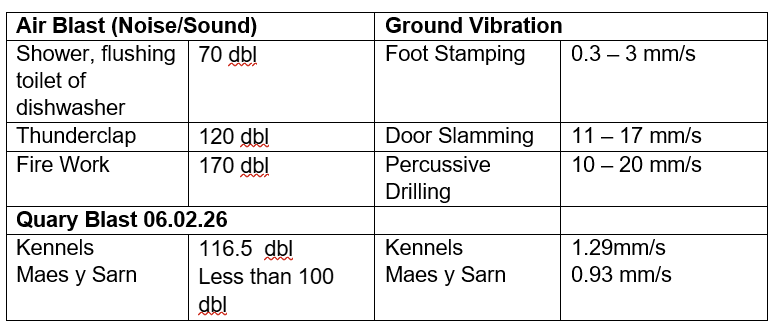
Ground vibrations are measured in mm/s and stated as a Peak Particle Velocity (PPV). Ground vibrations are seismic waves which travel through the ground.
The air blast, caused by the ‘boom’ has audible and inaudible noise and can cause discomfort, startle, rattle windows and radiators. The air overpressure or air blast is very much dependent on weather conditions, cloud cover, wind strength, wind direction, air temperature and topography/ landscape etc. This is measured in decibels (dBL). The air blast is often the most likely cause of annoyance from blasting.
When monitoring a blast there are two measurements taken. These are ground vibrations and noise/sound.
There is a limit within the quarry’s planning permission that ground vibrations from a blast do not exceed a PPV of 6mm/s in 95% of all blasts measured over any continuous six-month period and no single blast shall exceed 10mm/s. This is measured at or near the foundations of sensitive buildings. There are no specified limits set within planning permission for the air blast, although 120 dBL (decibels) is usually considered acceptable.
In terms of ground vibrations, published research and guidance suggests that at around 0.2mm/s ground vibrations are perceptible by people. Cosmetic damage (hairline cracks in plasterwork) to residential buildings would not be expected to occur at vibration levels typically less than 12 mm/s. Structural damage to residential buildings would not be expected to occur at levels typically less than 50 mm/s.
Windows are usually the weakest part of the structure. Published research and guidance has shown that a poorly mounted pre-stressed window may crack at around 150 dBL from an air blast. Structural damage would not be expected at levels below 180 dBL for an air blast.
The monitoring location at the kennels off Tyn-y-Coed Road usually records the highest levels of air blast and ground vibrations. This is due to the kennels being the nearest monitoring point to the quarry. The blast on the 6th February 2026 measured an air blast value of 116.5 dBL with the ground vibrations recording a Peak Particle Velocity (PPV) of 1.29mm/s.
On the 6th February 2026 monitoring equipment located on Maes-y-Sarn recorded a PPV of 0.93 mm/s and an air blast of less than 100 dBL. The monitoring equipment used to record the noise from the blast had a trigger level set at 100 dBL. Therefore, if noise levels are less than this the equipment does not record the noise. This is considered normal practice as it prevents background noise from being recorded.
This information has helped us to understand that the ability of people and animals to sense the vibrations is far greater than the risk of damage to property. This is reflected in the feedback we receive from residents that some are not aware a blast taken place while others have felt the noise or vibration.
It should also be noted that where the blasting takes place within the quarry may affect different areas in the community.
If you are particularly affected by the blasting, please contact PCC & we will request the quarry carry out vibration testing in your area.
We will continue to work with the quarry to monitor and reduce the noise and vibration levels, listen to residents' experiences and where possible, to minimise the impact on residents and their pets. To this end Cardiff County Council have an additional monitor that can also be used.
Further information can be found at:-
Blasting flyer.pdf.downloadasset.pdf
Quarry Facebook Page
https://www.facebook.com/groups/StopCreigiauQuarry/?ref=share
Excerpt from Letter to residents from Rhys ab Owen - 17.03.26
“I am writing with regards to the work I have been undertaking so to assist those living near Taffs Well and Creigiau quarries.
Having received complaints about noise disturbance, dust, and vibrations, I'm now in contact with both Cardiff Council and Natural Resources Wales.
My requests include:
a review of whether the quarries are operating within the planning permission granted;
details of what checks have been made to see if the works are causing geological displacement;
that monitoring of vibrations be more widespread, and information made available as to how households can request monitoring kits”.